After EXIT stopped staging its flagship festival in Serbia amid a dispute over political pressure, the organization is expanding events around the world. In Montenegro, I saw why that could be as important for tourism as it is for music.
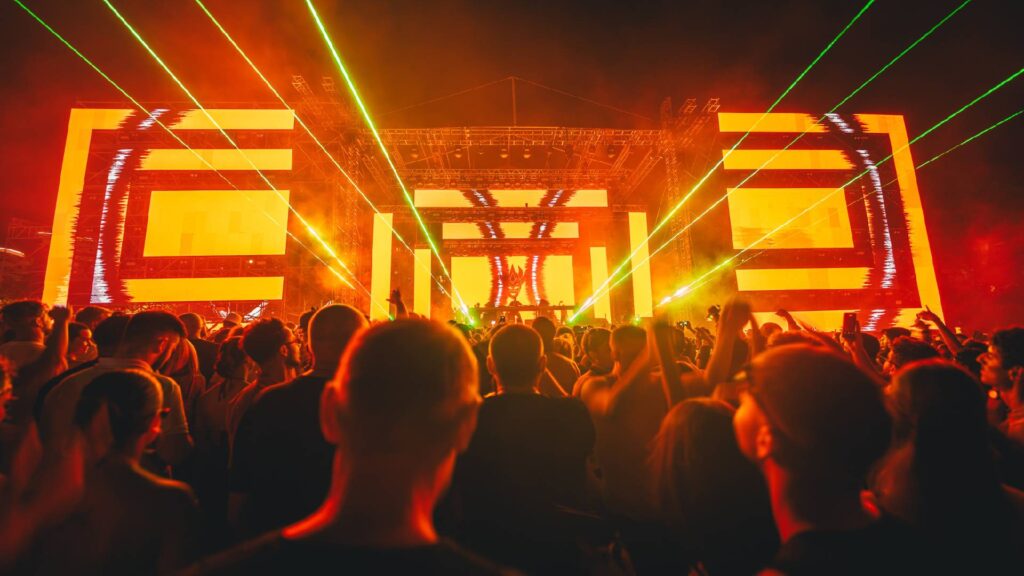
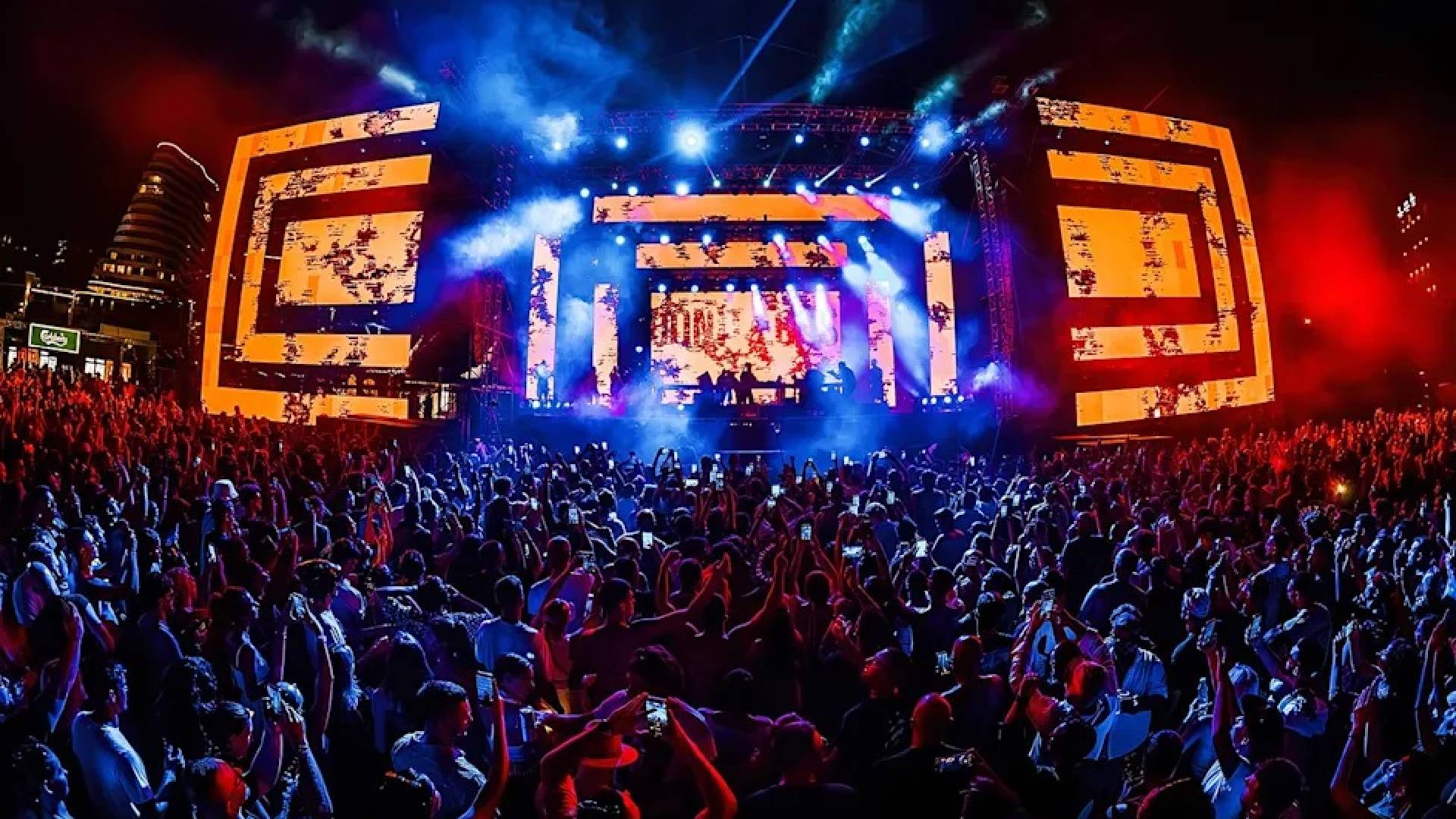
Sea Dance Festival kicks off in Montenegro as a massive crowd gathers under brilliant stage lights and massive LED screens for a high-energy performance. (EXIT 2 Montenegro)
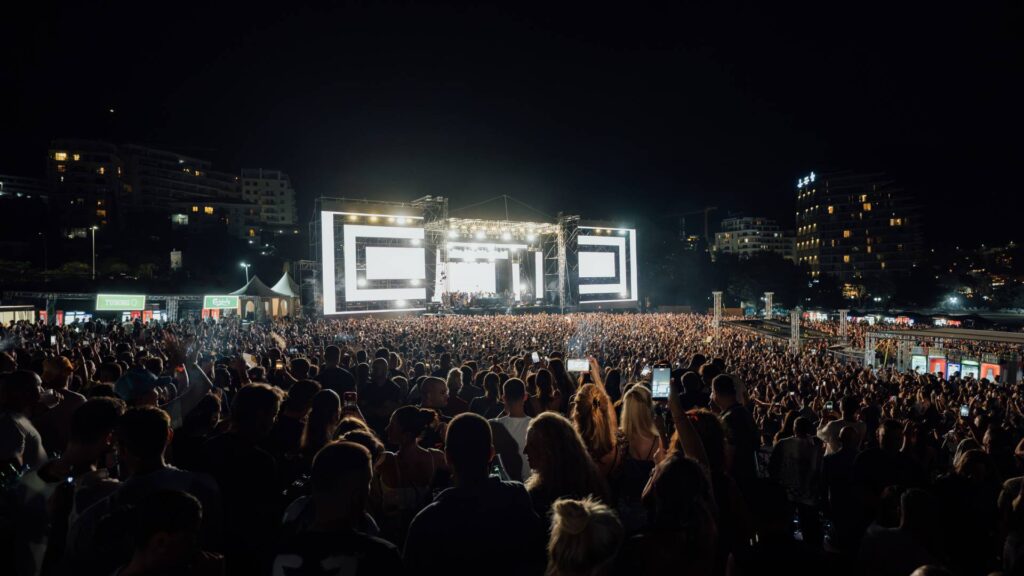
By midnight, Bečići Beach barely resembled the Montenegro beach resort I had spent the day exploring.
Thousands of people were packed along the Adriatic, lights were bouncing off the water, and Charlotte de Witte was playing techno practically on the sand. Around me were people who had traveled from across Europe and much farther afield, many of whom had built an entire Montenegro vacation around three nights of music.
That was the moment I realized EXIT’s latest chapter isn’t really just a festival story, but also a tourism story.
I had come to Montenegro at the end of August for Sea Dance, the second part of the new EXIT to Montenegro project. During the day, I did what I would have done on almost any trip here: took a boat out along the coast, swam in ridiculously clear Adriatic water, explored around Budva and wandered through its stone-walled Old Town. At night, I walked onto the beach to see artists including Charlotte de Witte, HUGEL, John Newman, Boris Brejcha and Enrico Sangiuliano.
That combination is precisely why destination festivals have become such a valuable tool for tourism.
The music might convince someone to book the flight, but the destination gets everything that happens after.
Across the two Montenegro events, organizers said 144,000 people passed through the festival gates. Sea Dance alone accounted for 93,000 across its three nights and drew visitors from more than 100 countries. The largest international visitor groups came from Germany, the UK, Turkey, Italy, Poland, France and the United States, according to EXIT.
EXIT’s difficult year has turned into a global experiment
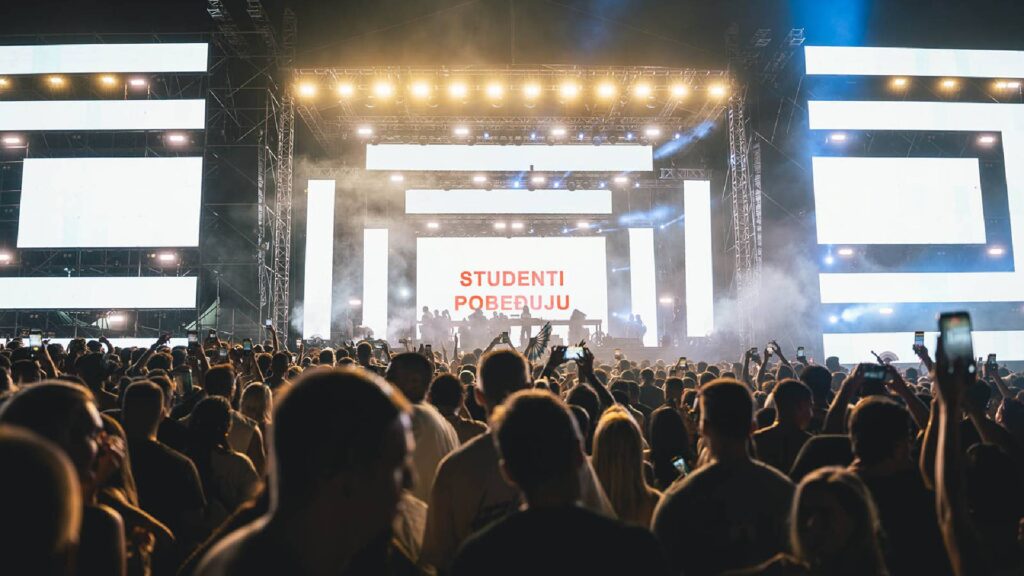
Bulgarian pop singer DARA (Darina Nikolaeva Yotova) delivers a high-energy performance with her dancers on the main stage at the Sea Dance Festival during the EXIT 2 Montenegro event series.
For more than two decades, EXIT and Serbia were almost inseparable.
The festival began in 2000 as a student movement advocating for peace, democracy and political change, eventually evolving into one of Europe’s best-known music festivals at Petrovaradin Fortress in Novi Sad. Then its relationship with Serbia’s government deteriorated.
EXIT says public co-funding was withdrawn after the organization supported the country’s student protest movement. Founder and CEO Dušan Kovačević told journalists that the fallout went much further, alleging that he personally faced threats and describing the situation as “very, very serious.”
Those allegations are his account of events. But whatever the dispute over why it happened, the practical result is clear: EXIT’s flagship festival isn’t taking place in Serbia in 2026. Instead, it has gone global, making 2026 an international tour.
The festival’s international standing remained strong during the transition: EXIT won Promoter of the Year at the European Festival Awards ceremony in January 2026.
Montenegro is one stop in a tour that also includes Croatia, Malta and Egypt, where EXIT is preparing a multi-day, multi-stage festival beside the Great Pyramids of Giza. EXIT has also said it has received interest from other destinations worldwide.
Kovačević described rebuilding the festival model in multiple countries as “changing the engine in an airplane while it’s flying.”
The analogy works because instead of returning every summer to the same fortress with established suppliers, regulations, and partners, EXIT is suddenly navigating completely different business environments and cultures.
“Now it’s completely different,” he told us, explaining that companies and partners operate differently in Egypt, Malta and Montenegro. At the same time, he said the upheaval is introducing EXIT to entirely new audiences.
That is the part that interests me most as a travel journalist, because EXIT isn’t simply taking its stages somewhere new. It is taking its audience with it.
Montenegro understands exactly what that audience is worth
A festival attendee standing at the front barricade during a live performance at the Sea Dance Festival for EXIT 2 Montenegro.
Montenegro’s government didn’t back EXIT because the country desperately needed somewhere for people to dance.
It backed it because people who travel to dance also sleep in hotels, eat in restaurants, take taxis, book boats, order drinks, visit beaches, and often stay several days beyond the event itself.
Before this summer’s festivals began, the Montenegrin government estimated that the two EXIT events in Ulcinj and Budva could produce at least 210,000 overnight stays and more than €40 million in direct tourism spending.
Those are extraordinary numbers for a country of just over 620,000 people.
The strategy was also unusually explicit. Government documents described the festivals as an opportunity for Montenegro to make a significant move into international event tourism, while EXIT said the project was designed in part to extend the country’s main tourism season.
Montenegrin Prime Minister Milojko Spajić described EXIT’s arrival as an opportunity for the country to raise its international profile and show off its “full potential, energy and openness.”
The first chapter took place on Long Beach in Ulcinj in July and, according to EXIT, attracted more than 50,000 visitors over three festival nights.
Then came Budva. Sea Dance ran on Bečići Beach from August 28 to 30, effectively placing a major international event at the opposite end of the peak summer season. Organizers said 93,000 people passed through the festival gates over the three nights.
And, yes, I was one of them.
And standing there made the economic logic far easier to understand than any tourism report could.
I came for EXIT, but I spent my money on Montenegro
Belgian techno icon Charlotte de Witte commands the decks during an energetic electronic music performance at the Sea Dance Festival for EXIT 2 Montenegro.
A festival traveler doesn’t exist in an economic vacuum. I needed somewhere to stay. I ate in local restaurants. I traveled around Budva. I went out on the water. I spent time at the beach. I explored the Old Town.
Then I went to the festival.
Multiply that behavior across tens of thousands of visitors and a three-night event starts to look less like entertainment and more like a temporary tourism economy.
It helps that Montenegro lends itself unusually well to this kind of travel.
You don’t have to choose between a beach vacation and a festival weekend here. You can swim in the Adriatic in the afternoon, walk through a centuries-old town before dinner, and watch one of the world’s biggest electronic artists on the beach that night.
The destination isn’t something you leave behind when you enter the festival gates, but is genuinely part of the experience.
And because both major EXIT to Montenegro festivals were free with registration, the proposition becomes even more interesting. Instead of asking a traveler to spend hundreds of euros on admission alone, the project effectively removes one of the largest costs associated with festival travel. It leaves visitors with more reason (and potentially more money!) to spend within the destination.
That is a very different way of thinking about what a festival ticket is supposed to accomplish.
Music can put a destination on someone’s radar
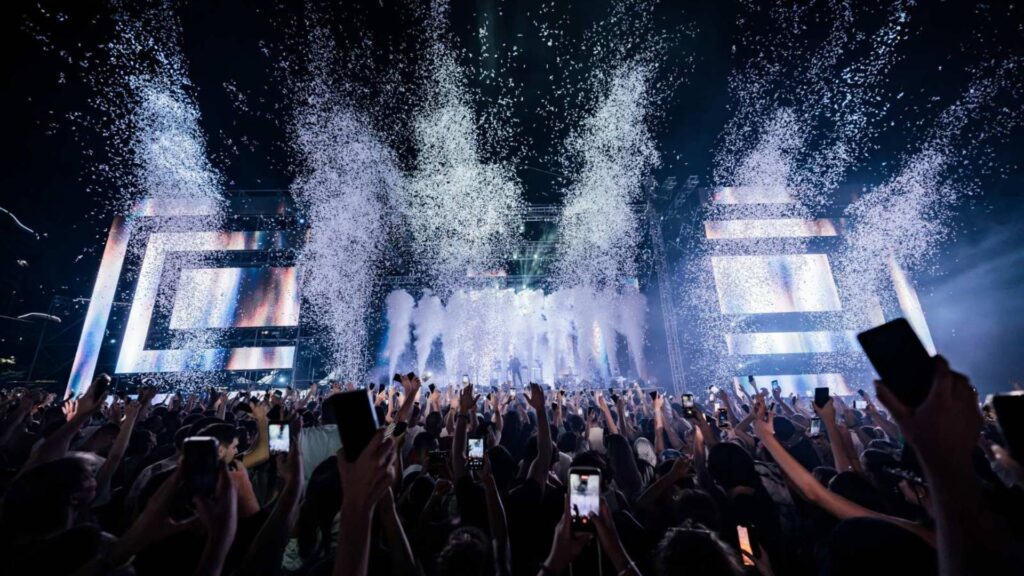
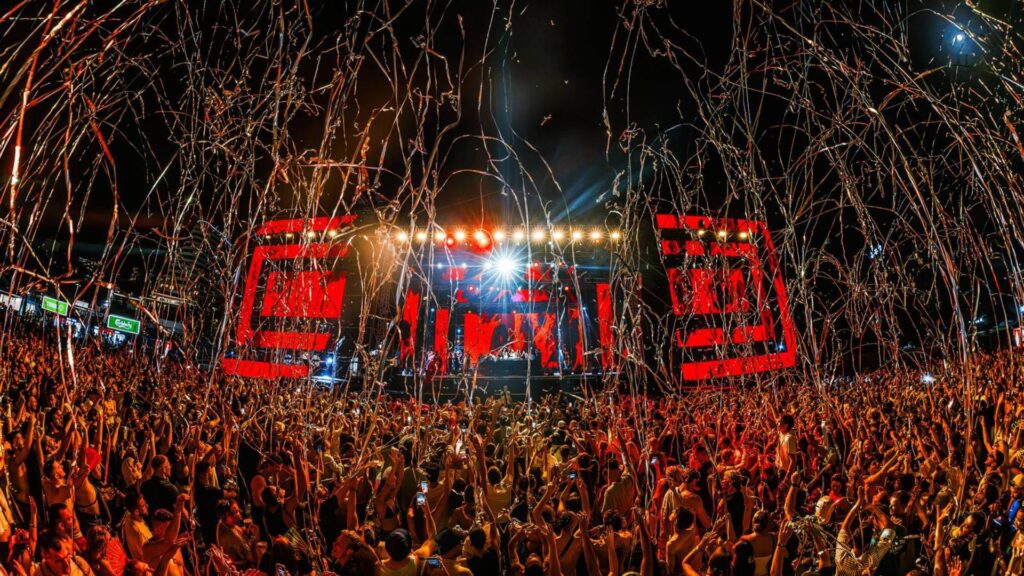
A festival attendee celebrates on a friend’s shoulders as a cascade of silver streamers rains down on the energized crowd at Sea Dance Festival during EXIT 2 Montenegro.
Festivals can introduce people to places they weren’t previously considering. Before the events in Montenegro began, EXIT reported more than 40,000 registrations, with particularly strong interest from the UK, Turkey, Germany, France, the Netherlands, Switzerland, Italy and Spain. Registrations had also come from the United States, Canada, Australia, the UAE and Brazil.
Some of those people probably already knew Montenegro. Some likely booked because they wanted to see Charlotte de Witte, HUGEL or another favorite artist and then discovered Montenegro almost incidentally.
For a small country competing for international attention with Croatia, Greece, Italy and the rest of the Mediterranean, that matters enormously.
Traditional tourism marketing tells travelers why they should visit a place. A festival gives them a reason to go now.
And once they arrive, the destination can sell itself.
It certainly did for me. I didn’t leave Montenegro thinking only about who I had seen perform. I left thinking about Budva, the mountains dropping into the Adriatic, the beaches, the boats and how surprisingly easy it would be to return for a longer trip. That may ultimately be more valuable than a festival attendee who buys a ticket and disappears.
EXIT is looking for places as memorable as its stages
Regional hip-hop groups Who See and Bad Copy pump up a massive outdoor crowd while performing on the main stage at the Sea Dance Festival for EXIT 2 Montenegro.
Kovačević seems acutely aware that destination matters.
When we asked where EXIT could expand next, he said the organization has received invitations and even interest from many countries around the world, including the United States, but that the setting is fundamental.
“The locations that we’re doing events in are iconic, like the events,” he said.
That helps explain Egypt: a dance festival beside the Great Pyramids doesn’t require much of a marketing pitch. The image itself travels around the world.
But the same principle works on a smaller scale in Montenegro. Electronic music on an anonymous festival field is entertainment. Electronic music with the Adriatic behind the stage is a travel experience. EXIT’s history suggests it already knows how powerful that distinction can be.
Kovačević recalled the role British travelers played in turning EXIT into an international event, telling us that around 12,000 people from the UK attended in 2009 alone. Now, rather than depending on audiences traveling to one Serbian city every summer, EXIT can potentially introduce its brand to travelers in multiple countries.
That creates a potentially powerful exchange, when EXIT brings the audience and the destination brings the reason to stay.
EXIT carries on with its mission in Montenegro
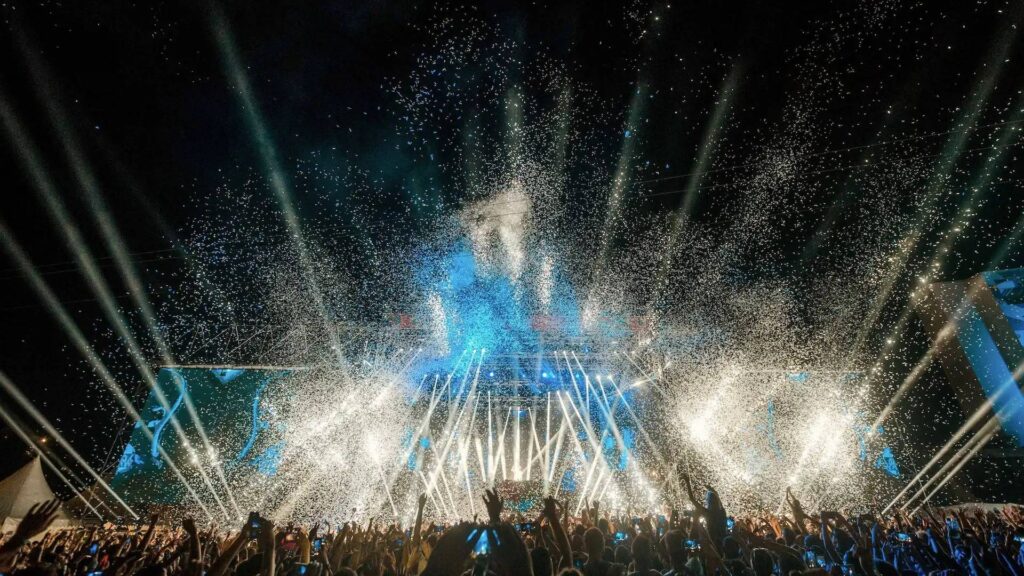
A stunning night view shows the coastal stage at Sea Dance Festival during EXIT 2 Montenegro as a massive crowd gathers along the illuminated waterfront.
One of the most prominent features was the 12-meter “Ivana” sculpture, which appeared at both Montenegro events and transformed after dark through lighting and 3D mapping.
The sculpture is dedicated to Ivana Kovačević, a mother of three, wife of EXIT founder Dušan Kovačević, and longtime member of the EXIT team, who died last year after a serious illness. Conceived as a deeply personal tribute, it also conveyed messages of enduring love, the feminine principle, and the protection of nature, particularly Long Beach in Ulcinj.
The Montenegro chapter also had a humanitarian dimension. EXIT’s “United for Kids” charity evening raised funds for a rehabilitation house for children recovering from cancer treatment, and a local day center for children and young people with disabilities. John Newman, who has spoken publicly about his own experience with a brain tumor, supported the initiative with an intimate performance.
It was another reminder that EXIT’s expansion is not simply about taking a lineup from one country to the next. The organization is trying to carry parts of the identity it created in Serbia into this new international chapter.
The challenge will be growing without losing what made EXIT different
German techno DJ Boris Brejcha plays to an energized crowd amid bursts of smoke and confetti on the main stage at the Sea Dance Festival during EXIT 2 Montenegro.
EXIT was born from activism, not tourism strategy. It grew from a Serbian student movement into an international festival without initially being conceived as a global hospitality product. Now governments and tourism destinations can look at the brand and see visitor numbers, international exposure and millions of euros in potential spending.
Can EXIT grow without diluting the activist identity that makes it distinctive?
Kovačević believes it can.
“It’s really something that is done from the soul, from the mission,” he told us when asked what distinguishes EXIT. His invitation to people discovering the festival for the first time was simple: “Come and feel that energy, come and feel the purpose.”
He still talks about social activism as one of EXIT’s fundamental pillars, alongside the music. And while individual events will adapt to their destinations, he said the organization wants to preserve that sense of purpose.
That could become harder as the festival grows.
But EXIT’s strange, politically charged transition may have inadvertently created something fascinating for the travel industry: an internationally recognized festival brand suddenly being deployed across destinations worldwide. Montenegro provides the first convincing case study of what they might do with it.
The smartest festivals don’t just sell tickets. They sell trips
Gold streamers rain down on a celebrating crowd during a spectacular headline performance at the Sea Dance Festival for EXIT 2 Montenegro.
When travelers cross borders for an event, the destination gets a customer before the first artist even takes the stage. Every extra night in a hotel, every meal, boat trip, taxi ride, and return visit expands the value of that initial decision to travel.
Montenegro’s government has effectively bet that bringing EXIT to its coastline will produce enough of those decisions to matter.
After seeing Bečići Beach packed at the end of August, I understand why.
The flagship EXIT Festival’s departure from its traditional Novi Sad home could have been an existential crisis for the organization. Instead, it is beginning to look like the catalyst for something considerably larger: Croatia, Malta, Montenegro, Egypt and potentially more destinations to come.
Kovačević himself doesn’t know exactly where it ends.
“This is a story in the making,” he told us.
So is Montenegro’s attempt to become a serious music-tourism destination.
But after spending my days exploring the country and my nights dancing beside the Adriatic, one thing seemed clear: the future of the destination festival isn’t convincing people to spend their vacation inside a festival.
It’s using the festival to convince them to take the vacation in the first place.